
 Fiber Grade
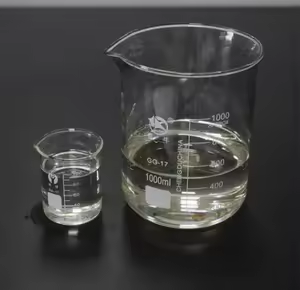
Mono Ethylene Glycol (MEG) is a clear, colorless, odorless, and sweet-tasting liquid. It is a vital ingredient for the production of Polyester Fibers (PSF), PET Resins (Bottles), and Engine Coolants. Ruvon supplies Fiber Grade MEG with ultra-low iron and impurities, ensuring high brightness in textile applications.
MEG is a diol (alcohol with two hydroxyl groups). This chemical structure allows it to react with acids to form esters and polymers. Our Fiber Grade MEG is manufactured to strict specifications to prevent discoloration during the high-temperature polymerization process used to make clothes and bottles.
Conforms to Fiber Grade Standards.
| Parameter | Specification Limit |
|---|---|
| Purity (MEG) | 99.9% Min |
| Diethylene Glycol (DEG) | Max 0.05% |
| Water Content | Max 0.05% |
| Acidity (as Acetic Acid) | Max 10 ppm |
| Iron (Fe) | Max 0.1 ppm (Critical) |
| UV Transmittance (220 nm) | Min 70% |
| UV Transmittance (275 nm) | Min 90% |
| Color (Pt-Co) | Max 5 |
MEG has two "arms" (Hydroxyl groups -OH). Purified Terephthalic Acid (PTA) has two "hooks" (Carboxyl groups).
Water normally freezes at 0°C. When you add MEG, it interferes with the formation of ice crystals. A 50/50 mixture of Water and MEG doesn't freeze until -37°C. This property protects car engines from bursting in winter and boiling over in summer (it also raises the boiling point to 129°C).
The primary use globally. Used to make Polyester yarn for clothing, carpets, and upholstery.
Used to manufacture PET chips for beverage bottles, food containers, and films.
Used in automotive radiators and industrial chillers to manage heat transfer.
Used in paints and coatings to improve flexibility and durability.
Used in paper, leather, and adhesives to retain moisture and prevent drying.
Used to remove water vapor from natural gas pipelines to prevent corrosion.
Standard heavy-duty drums. Virgin packing ensures purity.
Bulk supply (20-25 MT) for large textile and PET plants.
Although it has a high flash point (111°C), precautions are necessary.
99.9% Purity. Ultra Low Iron. Direct Import.
Don't worry, we won't spam you with emails.
Ruvon International Pvt. Ltd.
Global chemical sourcing and supply.
A/6, Parimal Soc-2, Behind Sardar Estate, Ajwa Road, Vadodara, India - 390019
+91 97730 71752
+91 77780 56001
info@ruvonchemicals.in